The CDC recommends that medications be kept within specific refrigerated and frozen temperature ranges to ensure safety and efficacy (Vaccine Storage and Handling Toolkit).
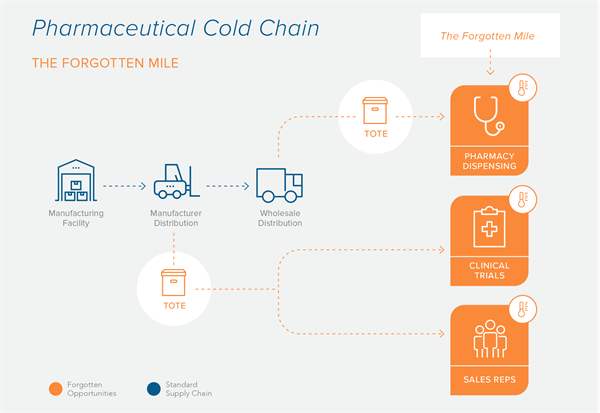
Drug manufacturers are well aware of these recommendations and take precautions to properly store their medications. However, there is a link in the Cold Chain that is often overlooked. We refer to that missing link as the “Forgotten Mile.”The Forgotten Mile is the section of the cold chain where pharmaceuticals are stored for clinical trials, sales rep distribution, and pharmacy dispensing.
Clinical Trials
The majority of today’s Investigational Medicinal Products (IMPs) are temperature sensitive and require cold chain storage, particularly for oncology and large-molecule research. The success of a clinical trial depends on the integrity of the IMP being tested. If the IMP is exposed to unfavorable conditions, it could negatively impact the results of the trial.
Typically, transported in totes or foam eskies, IMPs need to complete their journey from the manufacturing facility to the clinical trial site in the same condition that they started in. Monitoring the temperature of your totes is essential to ensure quality and efficacy.
Sales Reps
Pharmaceutical sales reps spend much of their time on the road driving from office to office and hospital to hospital. With them, they are carrying various drug samples, many of which are temperature sensitive. To ensure quality, sales reps must maintain appropriate storage temperatures for the samples while on the road. Monitoring of sample totes can give real-time temperature information and alert sales reps immediately if there is an excursion that could negatively impact the integrity of the samples.
Pharmacy Dispensing
Pharmacy dispensing takes place at retail pharmacies, nursing homes, doctor’s offices, hospitals, and clinics. Storage conditions vary substantially based on the quality of equipment. SmartSense’s monitoring systems provide you real-time notification, reporting, and quality control.
Where the product can still leave range
Manufacturers already store these medicines in range. The forgotten mile is what happens after that: a clinical-trial tote, a sales rep’s car, or a pharmacy, clinic, or nursing-home refrigerator. Each of those stops can undo the precautions taken at the plant.
For a trial, the investigational product has to arrive in the same condition it left in, because a temperature excursion can affect the result. For a sales rep, the sample tote is the storage unit, and an alert only helps if it fires while the rep can still act. For dispensing, the equipment varies by site, so a real-time reading and a record matter more than a single warehouse log.
Related reading
For more on shipment visibility, read How to Integrate Supply Chain Tracking to Protect Perishable Assets in Transit and Securing the Supply Chain for Food Service, Laboratory Research, and Vaccine Administration.