
As the demand for convenient, fast, and quality food continues to rise, small QSR chains face increasing pressure to deliver exceptional customer experiences while maintaining operational efficiency. Given this highly competitive market environment, IoT-enabled smart tools are beneficial to QSR chains of any size to ensure that they stay ahead of the competition.
In a seamless digital customer experience, onsite and mobile experiences are integrated from order and payment to preparation and delivery. At the core of a successful experience are a QSR’s deskless workers empowered by IoT technologies. Smart tools are integrated into their daily operations that automate time-consuming, routine tasks. These tools also generate real-time data-driven insights to ensure an efficient, safe, and positive experience for both customers and deskless workers.
Common operational challenges for small QSR chains

In today’s ultra-competitive market, QSRs face a variety of operational challenges in delivering a customer experience that maintains both customer loyalty and healthy profit margins.
- Food safety and compliance risks: Accurate and timely temperature checks during storage, preparation and holding are crucial to comply with state and federal regulations.
- Labor shortages: With 132,000 vacancies across the QSR sector and only 54% of employees reaching 90 days of work before quitting, high churn makes attracting, training, and retaining staff difficult and costly.
- Rising costs: Managing inflation and profit margins while meeting customer expectations calls for a strategy balancing competitive pricing and the promise of quick, quality, affordable food.
- Changing customer expectations: With studies predicting that diners want increasingly diversified offerings, QSRs must meet evolving demands for convenience and healthier options while maintaining a consistent, fast, efficient customer experience.
- Consistency of customer experience: To retain customers in a fickle market and balance speed of service with dining satisfaction, QSRs must scale operations to ensure that food safety and quality, portion size consistency, and customer service are identical across all sites and all shifts.
The deskless QSR worker: frontline, customer-facing, and mobile-first
Deskless workers, also known as frontline, hourly, or shift-based workers, comprise 80% of the global workforce — perhaps even more of the QSR sector. Typically employed in a fast-paced environment comprised of both digital and customer-facing interactions, deskless QSR workers are mobile-first: they use mobile technologies (tablets, smartphone, scanners) to prioritize speed, convenience, and functionality.
QSR deskless workers include the following roles as part of the total customer service experience:
- Cashiers: take orders and process payments
- Servers: take orders and deliver meals
- Bartenders/Baristas: take orders and prepare beverages
- Hosts: manage reservations and seating
- Drivers: transport meals and update delivery times
- Floor Managers: communicate with front of house and kitchen
IoT-enabled smart tools that support QSR deskless workers

Investing to improve efficiencies and the customer experience in a QSR chain comes down to investing in IoT-enabled tools that support deskless workers. The following smart processes benefit both the QSR worker and enterprise by automating what were formerly manual procedures. Digital sensors, dashboards, and analytical software improve operations, save time and money, and ensure an optimal customer experience.
Automating routine tasks
Automating routine tasks in a QSR chain improves efficiency and productivity by reducing human error, cutting costs, and filling labor gaps. IoT-enable sensors, digital probes, and dashboards shift routine tasks from manual pen-and-paper methods to digital automation.
Free from these time-consuming tasks, deskless workers can focus more on high-value customer interaction and quality service. And because many routine tasks are repetitive and tedious, digitization reduces worker boredom and improves job satisfaction.
Digitizing food temperature monitoring
Food temperature monitoring is the most important routine task at a QSR to ensure food safety and quality. For that reason alone, its automation is crucial. IoT-enabled sensors in coolers, freezers, kitchens, holding areas, and delivery docks continuously monitor food temperatures and send time-stamped readings wirelessly to a central dashboard. Analytical software can then generate audit-ready HACCP logs for irrefutable proof of compliance.
IoT-enabled food temperature monitoring minimizes temperature deviations, bacterial growth, spoilage, foodborne illness, costly recalls, product waste, negative reviews, potential fines, and legal fees. If a temperature excursion does occur, the monitoring system sends immediate alerts by text or email to deskless workers. These notifications include prescriptive guidance for taking the best corrective action to minimize potential damage.
Predictive equipment maintenance
Predictive equipment maintenance shifts from reactive fixes to scheduled, necessary upkeep, thereby reducing overall spend. IoT-enabled smart tools can diagnose the health and lifespan of a QSR’s essential equipment. Sensors in coolers, freezers, warmers, ovens, fryers, walk-ins, and storage areas continuously monitor critical parameters such as temperature, humidity, air flow, and energy use.
Using data-driven trends to identify inefficient and failing units before they break down has multiple benefits. Regarding equipment, forecasting avoids costly emergency repairs, prevents minor issues from causing cascading damage, improves equipment performance and safety, extends asset life, and helps maintenance teams decide when to replace rather than repair. Regarding deskless workers, predictive maintenance ensures kitchen operations run smoothly by minimizing unplanned downtime, eliminating overtime to make repairs, and allowing for targeted training to ensure correct settings, minimize overuse, and provide guidance for proper food storage.
Prescriptive digital checklists
Prescriptive digital checklists move QSRs from reactive management to proactive, data-informed operations. They provide built-in guidance to make sure deskless workers (especially new hires) complete every task consistently, correctly, and on time. Instant updates to a checklist can be deployed to all locations immediately. And multimedia integration lets managers provide visual presentations of proper task procedures, while deskless workers can attach photos and videos to demonstrate task completion.
Managers can track worker progress and get instant insights into operations. Greater visibility helps them address issues quickly, maintain high standards, and make faster, smarter decisions on the floor. Deskless workers themselves are made more accountable. The system automatically logs the identity of the worker who completed tasks with time-date stamps, thus eliminating guesswork and improving ownership.
Digital management of printed food labels
Digital management of printed food labels offer many benefits:
- Accuracy: Eliminate human error to ensure that information on pricing, ingredients, sourcing, expiration dates, allergen warnings, and nutrition facts is always up-to-date and correct.
- Efficiency: Create and print labels much faster, reducing prep time and manual effort.
- Consistency: Ensure uniform, professional labels across all food items and locations.
- Sustainability: Reduce paper waste and food waste by providing clear, accurate descriptions, thereby preventing unwanted purchases.
- Transparency: Build customer trust and loyalty with comprehensive information about product journeys from farm to fork.
Digital information library
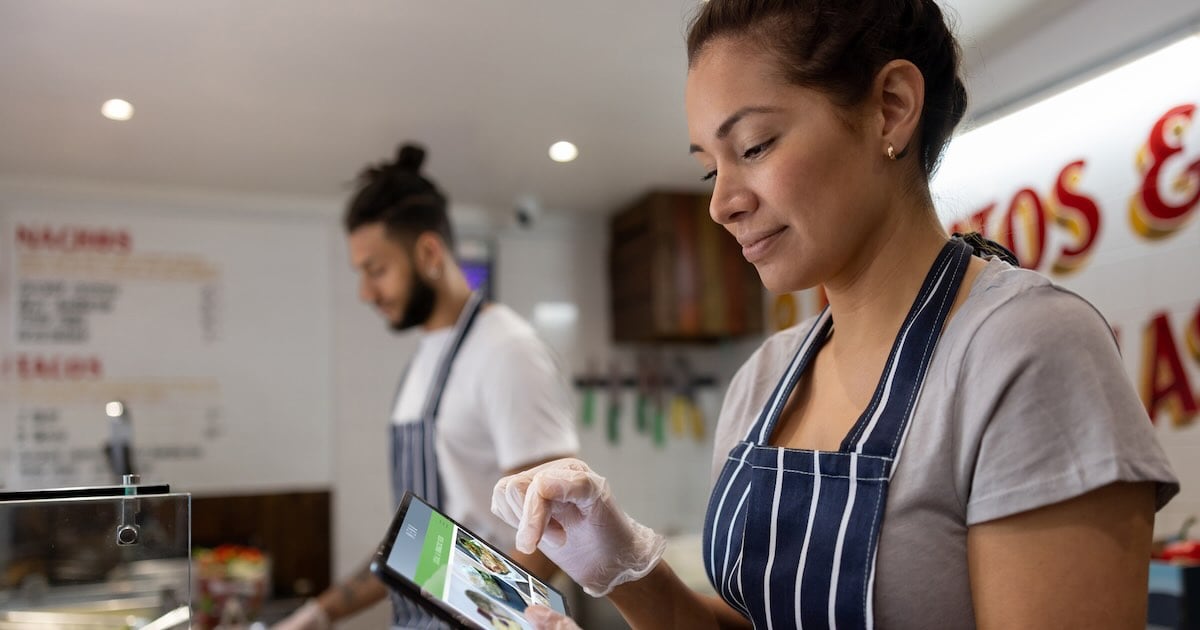
A QSR digital information library is a centralized cloud-based knowledge database for deskless workers. They can access important information on tablets or smartphones anytime they need it. This information includes training videos, standard operating procedures, detailed recipes, allergen guides, and critical safety rules.
A digital information library has many benefits:
- Onboarding and training: Delivered by mobile-friendly platforms, short, video-based lessons (microlearning) and on-demand guidance for correct action (prescriptive tasks) make learning more flexible and accessible than traditional classroom sessions.
- Efficiency: Instant access to crucial information means fewer questions to supervisors.
- Consistency: All deskless workers across all shifts and locations follow the latest procedures.
- Empowerment: Deskless workers are more confident they can solve problems correctly and efficiently.
To succeed in the QSR sector, small and medium-sized restaurant operators must play a balancing act: between low costs and high quality, between fast service and consistent delivery, and between managers on the floor and workers without desks. IoT-enabled smart tools maintain that balance with less time, money, and labor than traditional manual systems.
Learn more about our acquisition of Jolt to enhance our Sensing-as-a-Service solutions for QSRs.
Related reading
For more on QSR operations and deskless teams, read How technology can help improve your QSR speed, The New Age of Employee Accountability Software: Forget Micromanagement – Think Digital Empowerment, and Fast Casual Attitudes on Food Safety, Value, and Loyalty in 2026.