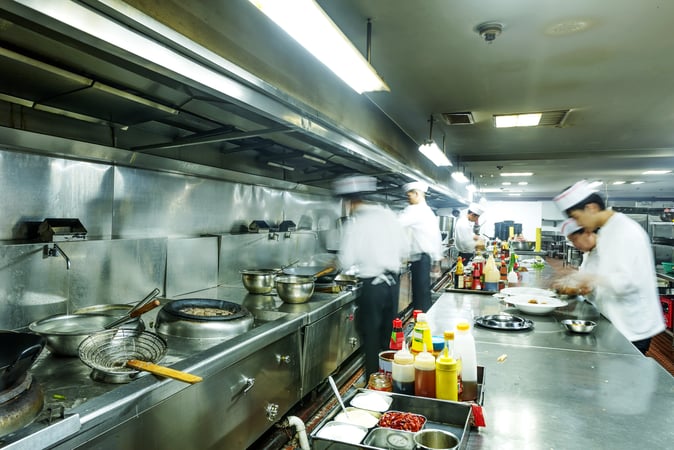
If you’re responsible for food safety for a large restaurant chain, then you know that regulations are not consistent across the nation. Instead, You may have to juggle federal, state, and local guidelines, which can be quite a burden. So, rather than trying to meet dozens of minimum compliance rules, which is a reactive approach, a better plan is to institute your own set of internal best practices that you know will always meet, or better yet, exceed regulations. Taking this proactive strategy helps you avoid the risks of foodborne illness and protect your brand. Establish effective Good Retail Practices (GRP) The first step is to establish universal Good Retail Practices. This is a highly proactive way to assure that your food products are not contaminated by biological, chemical, or …
Articles from SmartSense by Digi
Recent Posts

As with all transformative technologies, IoT has been the source of an inordinate amount of hype but has also been a catalyst for the digital industrial revolution. General Electric’s chief economist Marco Annunziato estimated that Industrial and Enterprise focused IoT could add between 10 and 15 trillion dollars to global GDP. These gains come through small, incremental improvements in the world’s industrial assets. While this is encouraging, this growth is not a foregone conclusion. It requires a robust IoT ecosystem to solve the market’s problems efficiently and elegantly. SmartSense, founded at MIT, has been part of the IoT ecosystem since 2005 with a focus on automating food safety and pharmacy safety processes for some of the largest enterprises in the world. We believe that our …

Accurate temperature monitoring is necessary to ensure the safety and efficacy of all medications and vaccines. That should be a given in the pharmacy industry. But the truth is, for many pharmacy chains and independents, temperature monitoring is merely guesswork. Too frequently staff responsible for temperature monitoring don’t understand the “why” of recording temperatures. And when we don’t understand why, we often don’t realize the “how” either—that is, some methods are better than others. In this blog post, we’ll demonstrate that manual clipboard monitoring, the status quo for most pharmacies, not only should be but will be replaced by continuous remote monitoring. We’ll start with a high-level overview of the issues, including: The current status of state regulations The probable …

In our blog post about refrigerator temperature monitoring, we discussed the driving factors behind food waste within the restaurant industry, and we debunked the misconception that restaurants are exposed to liability risk if they donate their leftover food. In this post, we take a look at FoodShare, a Food Donation Program implemented by Starbucks in 2016. This case study, which was recently presented at the 2017 Food Safety Summit, demonstrates how strong food safety programs with temperature monitoring for freezers and walk-in coolers enable food rescue programs and reduce food waste. FoodShare: A Partnership of Starbucks and Feeding America In 2016, Starbucks established a partnership with Feeding America, the largest not-for-profit organization in the U.S. devoted to hunger relief …

If you’re still using a paper temperature log, then there is a very high probability of undiscovered thermal excursions in your fridges and freezers. Accompanying these unseen excursions is a high likelihood of you administering ineffective vaccines and medications. To mitigate temperature damage, more and more pharmacies are moving to continuous temperature monitoring. Combining wireless sensors with real-time temperature logging and alerts is enabling pharmacies to improve their visibility and take corrective action when needed. Behind the move to continuous monitoring are a series of reasons that have a positive impact on both independent pharmacies, as well as large pharmacy chains. Efficiency A pharmacist's time is extremely valuable, and they should be spending that time …

Food waste is a pressing issue. Americans dispose of 160 billion pounds of food per year. That’s 40% of all food available, or 730 football stadiums full of discarded but safe food that is still edible. Many restaurants contribute to this waste when they dispose of unsold food at the end of the day. If just 30% of that wasted food were redistributed, it could feed all food insecure Americans their complete daily diet. In this post, we’ll take a look at why so many restaurants are disposing of their food rather than donating it to local food banks. Sell By” Dates Many people religiously follow the “sell by” or “best by” dates on food packaging. According to Harvard Law, 91% of consumers reported at least occasionally discarding food past its “sell by” date out of concern for the product’s …